Showing posts with label recession. Show all posts

Friday, May 23, 2025

News roundup, 23 May 2025

- A new study suggests that even if the increase in global temperatures is limited to 1.5°C (which seems increasingly unlikely), it's not going to be enough to prevent sea levels from rising by a centimetre per year by the end of the century. If the present course is maintained, it will be far worse - an eventual rise of up to 12 metres. For perspective, about 230 million people live no more than a metre above the current sea level, and a billion are within 10 metres. This would lead to a lot of migration, and the brutal truth of the matter is that if this migration can't be prevented by cutting emissions, it will be stopped with guns. That said, every fraction of a degree still matters, not least because it will mean fewer people getting shot at borders than there otherwise would be.

- On a somewhat more positive note, the deforestation rate in Brazil dropped by over 30% in 2024 compared to the previous year. Note, however, this only factors in intentional deforestation; losses due to wildfires reached record levels last year.

- The Trump regime is prohibiting international students from enrolling at Harvard University because the institution refuses to hand over information about some current students to the Department of Homeland Security.

- The US Senate's parliamentarian, a nonpartisan staffer tasked with the interpretation of Senate rules, has been overruled after advising that the revocation of California's waiver that gives it the power to regulate vehicle emissions was probably illegal. The last time the parliamentarian has been overruled was in 1975. Now I must admit to be a bit torn here, because the specific decision had to do with the body's filibuster rules, which I've generally thought should be scrapped as they often stop progressive initiatives. And seeing that these rules don't seem to be stopping reactionary initiatives, they should probably still be scrapped (or rather not re-adopted if and when the US becomes a functioning democracy again).

- TD's chief economist, Beata Caranci, is predicting that Canada will go into recession this year, and that some 100,000 jobs could be lost as a result.

- The Canadian Union of Postal Workers has opted for a work-to-rule campaign rather than a strike, for the time being. Significant service disruptions are expected to result simply as a result of workers refusing overtime.

- The Rural Municipality of Prairie Lakes in southern Manitoba has introduced a "one lake, one boat" policy, which will require visitors bringing boats to Pelican Lake to have the boats inspected for zebra mussels for a $40 fee. Naturally businesses are complaining, but such measures are sometimes necessary.

- Elon Musk's AI chatbot, Grok, has started injecting its answers with propaganda about "white genocide" in South Africa - even when the question had nothing to do with South Africa or race. This certainly underscores the need for regulation of AI; unfortunately in the US the prospects for that have dimmed as legislation to prevent the regulation of AI for at least 10 years has cleared the House and moved on to the Senate.

- Recycling collection in Winnipeg was disrupted yesterday due to an unexpected closure of the material recovery facility where recyclables are taken. The plant was closed for a police investigation after plant staff found a dead guy on the premises.

Wednesday, April 9, 2025

News roundup, 9 April 2025

- Many economists now think a global recession is almost inevitable unless the US changes course on tariffs. Of course, that probably won't sway the MAGA crowd; they'll just look for some outsiders to blame.

- UK Prime Minister Keir Starmer and his Chancellor of the Exchequer Rachel Reeves are considering doing something that was unthinkable in the neoliberal era even for the Labour Party - renationalizing British Steel. Of course, steel is a key strategic material for running any modern society, and when knockoff effects from the Trump regime's tariffs threaten to possibly end domestic production of the stuff in a newly uncertain geopolitical climate, it concentrates the mind wonderfully. It would be interesting to see if they go ahead with this, and if so, whether other social democratic parties in places like the EU, Canada, and Australia might follow suit. For instance, it wasn't long ago (well, 54 years actually, but...) that the Manitoba NDP government under Ed Schreyer directed the Manitoba Development Corporation to take over a struggling bus manufacturer and keep it afloat, then rather controversially sold it (creating what is now known as New Flyer) after it became profitable. Soon they might want to consider doing that again, only maybe without that last part.

- A suspect has been charged in the case of the woman who was run down and severely injured while crossing Osborne Street last month. Curiously, they have only been charged under the Highway Traffic Act, despite the fact that leaving the scene of an accident is a Criminal Code offense as well. Her family expressed a suspicion at the time that it wasn't an accident at all; even if it was, though, it's interesting that they didn't use that obvious charge. The police did specify that the suspect is definitely not a cop; the fact that they went out of their way to say that while saying little more about the suspect's identity is rather telling.

- US Commerce Secretary Howard Lutnick sees a lot of opportunities to bring manufacturing back to America without the problem of having to pay those pesky factory workers by replacing the latter with robots.

- Traffic at the border crossing between Emerson, Manitoba and Pembina, North Dakota has declined 17% compared to the same time last year. Once we get into times when there's more leisure travel the drop may well be considerably more, and people in the tourism industry in border states are getting worried. An odd footnote - an industry group, the Travel Health Insurance Association of Canada, conducted a survey that's mentioned in the article. Of the possible answers to a question about reasons people don't want to travel to the US, 57% of respondents cited tariffs as a factor, 51% cited political leadership, and 34% mentioned the low Canadian dollar. The fact that nobody cited the orange monster's threat to take over our country as a reason to not want to visit seems only explicable if that wasn't listed as a possible reason; that seems like a strange thing to leave out of such a poll.

- Donald Trump has signed several more executive orders aimed at increasing coal production in the US, mostly reversing the policies of previous administrations but also one that allows the Justice Department to "investigate" states that are "discriminating" against coal for energy production. One interesting quote comes up here:

The president said coal miners want to mine coal, not work in high-tech jobs or other fields. 

"You could give 'em a penthouse on Fifth Avenue and a different kind of job, and they'd be unhappy," Mr. Trump said, with the miners behind him. "They want to mine coal. That's what they love to do."

The thing is, there's actually an element of truth to that. There is a fairly large subset of the population that is so contrarian that they have made their backwardness and nastiness a huge part of their identity. These are the same kind of people who think that "environmentally friendly" is tantamount to "unmanly". And their response to society moving on is what Hunter S. Thompson called "an ethic of total retaliation". Unfortunately, most of those people can't be reasoned with; the best you can do is defeat them. Whether the latter is possible remains to be seen.

Friday, February 21, 2025

News roundup, 21 Feb 2025

- Given that many of Donald Trump's policies and appointments have been utterly ridiculous even by Republican standards, the question has to be asked about where the non-crazy Republican members of Congress are. Part of it is that they're afraid of being defeated in primaries, of course, but another possible reason has been mooted - they're afraid of being killed by Trump supporters. North Carolina Senator Thom Tillis was considering voting against confirming Pete Hegseth as defense secretary, but then turned around and provided the key vote to enable Hegseth's appointment to proceed. He has reportedly said in private conversations that the FBI has warned him of "credible death threats", though he publicly denies this, perhaps to avoid becoming a target anyway. He's apparently not the only one to privately express fear of harm at the hands of Trump's brownshirts either. Some are saying that Trump's betrayal of Ukraine might be a bridge too far, but I'll believe that when I see it.

- Hot on the heels of Trump's "border czar", Tom Homan, trying to get AOC arrested for allegedly "impeding" ICE's operations by informing people of their legal rights, we now have a Trump-appointed prosecutor investigating Chuck Schumer for comments he made about Supreme Court justices Brett Kavanaugh and Neil Gorsuch in the leadup to the Roe v. Wade decision. Apparently he addressed them by name on the steps of the Supreme Court, saying "You have unleashed a whirlwind, and you will pay the price". I suppose one could conceive of that as being a threat, but it's a stretch. The most likely reason, of course, is that the Trump regime is doing their darnedest to find any way of getting rid of enough Democrats so that they have a supermajority that could allow them to, say, successfully impeach liberal and moderate Supreme Court justices.

- Jesse Rothstein, who served as chief economist of the US Department of Labor during the Obama administration, warns that the massive civil service layoffs and cancellation of government contracts that Elon Musk's DOGE is pushing through are likely to cause a serious recession. If this is correct, it's just one more incentive for the regime to ensure that the 2026 midterms (not to mention the 2028 presidential election) are not free or fair, something they seem to be working on already.

- Elon Musk is now saying it's time to deorbit the International Space Station. After all, SpaceX already has a $843 million contract to do it in 2030, and he doesn't want to leave all that money just sitting there until then.

- One thing about Trump acting like a dictator is that all kinds of people and corporations are coming out of the woodwork with things they'd like him to dictate. For instance, Facebook parent company Meta is warning the EU that they're going to sic big daddy Trump on them if they dare to do such things as enforcing their own laws regarding privacy, protecting children, and the like. And a bunch of California Republicans are trying to get Trump to look into stopping the construction of a high speed rail line between San Francisco and Los Angeles, something he seems happy to oblige.

- Sweden's centre-right prime minister, Ulf Kristersson, is bleating that Europe risks becoming a "museum" unless they stop regulating artificial intelligence. I guess we know who most of the techies in that country vote for.

Thursday, February 17, 2011

Conservative austerity - Not what the doctor ordered

Brian at Just Damn Stupid has found this Bloomberg article which shows the folly of cutting budgets when the economy is rocky:

Sorry, fiscal austerity doesn’t work. For evidence, look no further than the U.K.

This can’t be good news for the U.S. political right, whose mantra has been: cut spending, put a lid on deficits, and growth will improve.

All sorts of good things, it is claimed, will spring from a turn to austerity that stops all this stimulus nonsense and prevents the Federal Reserve from doing more quantitative easing. Reductions in spending, according to a theory known as Ricardian equivalence, will do no harm because lower borrowing will automatically lead to higher private spending. Plus, of course, there is the notion of crowding out, meaning that reining in the public sector leaves room for the private industry to step in and all will be well.

This is dangerous hogwash.

There is little historical precedent in the real world, though lots of fantasizing in the made-up world of economic theorists, to suggest that fiscal austerity works. The best example of austerity’s failure is the double-dip that occurred in the late 1930s in the U.S., when spending was reduced too soon in a nascent recovery. In contrast, the U.K. didn’t have a double-dip because it was engaging in classic Keynesian spending as it began re- arming.

And as Brian goes on to point out, Hugh McFadyen's promise to balance the budget on an annual basis would require ridiculous budget cuts... not what Manitoba needs by a long shot.

Friday, December 24, 2010

Volcker fears for the future of America

Paul Volcker, who chaired the Fed through most of the 1980s, thinks the dollar is in trouble:

Former Federal Reserve Chairman Paul Volcker, who is chairman of President Barack Obama’s Economic Recovery Advisory Board, said the U.S. dollar is in danger of losing its role as a global benchmark currency.

“The growing question is whether the exceptional role of the dollar can be maintained,” Volcker told a gathering of New York civic leaders at the University Club of New York last night.

The decline of the U.S. economy, political gridlock at home, U.S. involvement in two wars and “festering” geopolitical issues in the Middle East and Asia have undermined the ability of the U.S. to influence global events, Volcker said.

From Bloomberg (h/t Eric Janszen in this iTulip thread). Not surprisingly, Volcker takes it for granted that this will be a bad thing. But perhaps most interesting is this:

Volcker offered no prescriptive solutions as he spoke in broad terms of the country’s loss of stature.

When a guy who's supposed to be in charge of America's economic recovery admits that he has no clue what to do about it, it certainly does look like that country is in trouble.

Tuesday, December 21, 2010

The US is even more strapped for cash than we thought

They're so broke it's starting to cut into their ability to kill people:
The United States executed fewer people this year, in part because there is a shortage of the drug used in lethal injections and because executions are too expensive in tough economic times, a report released Tuesday said.

The Death Penalty Information Center said in its annual report that executions decreased 12 percent this year and new death sentences stayed near the lowest level since capital punishment was reinstated in 1976.

From the London Free Press. The death penalty, paradoxically, is far more costly than imprisoning someone for life. The thing is, even societies that accept the death penalty don't feel comfortable if they get it wrong, so if someone's going to be executed they have to make sure they get it wrong as little as possible. And that means a lot of appeals, making sure that the accused has proper legal representation right up to the point when the last appeal is exhausted. Indeed, in some US states a person who is sentenced to death gets an automatic appeal whether they want it or not. Needless to say, that gets expensive.

What's striking, though, is that the US is one of the few modern democracies that has stubbornly clung to the practice of capital punishment. It's almost a fine old tradition there, and they don't give up their traditions easily. So for them to loosen their hold on it now is a sign that they're really broke.

Saturday, November 27, 2010

Irish bailout talks continue

The Irish government is still trying to negotiate terms for a bailout, having become overextended in bailing out the country's banks (among other things) while trying to keep taxes low (sound familiar?) The thing is, once they get a deal, they still have to get it through their minority parliament (Irish MPs are elected by multi-member single transferable vote, so majorities are virtually unknown there). And needless to say, a vote on this issue would be a vote of confidence. The government has already agreed to call an election immediately after the necessary legislation is passed, but when huge numbers of people are demanding that the government not agree to the austerity measures the EU and other backers demand in return for a €85 billion loan, one has to wonder if the government's coalition partners are going to be in the mood to co-operate. Several of them are independents, and following a by-election this past week (which was won by Sinn Fein, incidentally) the government has a majority of two seats assuming no defections.

One thing is clear - if Ireland defaults instead of accepting the bailout, things will get very interesting very fast. A lot of bondholders will lose a lot of money, of course, and unless the sky falls on the country quite a few other countries will follow their lead, compounding the situation. My money's on the sky not falling, by the way, though times will get a bit hairy for a while.

And even if Ireland doesn't default, Thomas Walkom in the Star reports that the markets aren't optimistic about two other troubled European economies:
The markets are also betting that two other euro nations, Spain and Portugal, will drop out of the common currency, default on their debts or do both.
Walkom, incidentally, thinks default is only a tiny part of the risks ensuing from this crisis:

Yet perhaps the most distressing element of the Irish crisis is the sense of déjà vu it creates.

In the ‘30s, nations faced with angry bondholders did exactly as Ireland’s government is doing now — raised taxes and cut spending in an effort to persuade financial markets of their fiscal rectitude.

Ireland is even lowering its minimum wage.

As in the 1930s, the Irish government is portraying its actions as inevitable.

As in the ‘30s, its cutbacks — by squeezing even more spending power from the economy — will only make matters worse.

And, as in the ‘30s, governments in Ireland and elsewhere will eventually find that their voters can put up with only so much.

The Great Depression boosted the fortunes of European fascism. We don’t know yet where the politics of this slump will take us.

But unless democratic governments show some imagination, the future doesn’t look pretty. Portuguese workers staged their largest one-day strike in 22 years Wednesday to protest government austerity plans. More troubles are on the horizon.

Now as hinted at above, the main beneficiary, politically, of the crisis in Ireland has been Sinn Fein. They certainly are not what most people would call fascist, though they do have a nationalist streak that bears watching. But as things degenerate in other countries, things could go very differently. Indeed, it already has in places (notably Austria and the Netherlands).

Thursday, September 30, 2010

Recovery stalls

A blip, or a double dip?
The Canadian economy shrank for the first time in 11 months in July, another clear sign of a slowdown, as factories, construction and consumer activity all posted declines.

The country’s real gross domestic product fell 0.1 per cent in the month, the first monthly drop since last August, Statistics Canada said Thursday.

Many measures of the economy have stalled in recent months, from job growth and housing starts to consumer spending and exports, as the global recovery petered out. The latest GDP reading will bolster expectations that the Bank of Canada will pause in raising interest rates next month, after three hikes in a row.
From the Globe. Will holding steady on interest rates be enough? Perhaps some stimulus programs need to be extended...

Tuesday, August 31, 2010

The "D-word" continues to appear

This time it's the Globe and Mail:
What’s a depression anyway? Basically, a depression is a very long recession.

You know you’re in a depression when interest rates go to zero and there is no revival in credit-sensitive spending.

The economy is in a depression when the banks are sitting on $1.3-trillion (U.S.) of cash and yet there is no lending going on to the private sector. It’s called a liquidity trap.

Depressions, usually, are caused by a bursting of an asset bubble and a contraction in credit, whereas a “plain-vanilla” recession is typically caused by inflation and excessive manufacturing inventories.

You tell me which fits the bill today.

It could be a long time before this settles down. But surely this will at least prevent the hyperinflationary scenario, right? Well, maybe not:
A minority, though—and God bless ’em—actually do go ahead and go through the motions of talking to the crazies ranting about hyperinflation. These amiable souls diligently point out that in a deflationary environment—where commodity prices are more or less stable, there are downward pressures on wages, asset prices are falling, and credit markets are shrinking—inflation is impossible. Therefore, hyperinflation is even more impossible.

This outlook seems sensible—if we fall for the trap of thinking that hyperinflation is an extention of inflation. If we think that hyperinflation is simply inflation on steroids—inflation-plus—inflation with balls—then it would seem to be the case that, in our current deflationary economic environment, hyperinflation is not simply a long way off, but flat-out ridiculous.

But hyperinflation is not an extension or amplification of inflation. Inflation and hyperinflation are two very distinct animals. They look the same—because in both cases, the currency loses its purchasing power—but they are not the same.

Inflation is when the economy overheats: It’s when an economy’s consumables (labor and commodities) are so in-demand because of economic growth, coupled with an expansionist credit environment, that the consumables rise in price. This forces all goods and services to rise in price as well, so that producers can keep up with costs. It is essentially a demand-driven phenomena.

Hyperinflation is the loss of faith in the currency. Prices rise in a hyperinflationary environment just like in an inflationary environment, but they rise not because people want more money for their labor or for commodities, but because people are trying to get out of the currency. It’s not that they want more money—they want less of the currency: So they will pay anything for a good which is not the currency.
From Gonzalo Lira, via ThePythonicCow in this iTulip thread. I'm not entirely sure what to make of this; it has a ring of plausibility to it, to be sure, though hyperinflationary scenarios are a favourite bugbear of the right and should thus be taken with sizeable quantities of salt.

Tuesday, July 27, 2010

Word of the day: Hysteresis

Those with a scientific background might recall this term from their high school physics classes. In that context, it refers to a property of ferromagnetic materials (like iron, steel, nickel, etc). If you wind coils of wire around a piece of steel and run electricity through it, the device becomes attractive to other magnetic materials. When the power is cut, the magnetism drops considerably... but not to zero. The tendency for the magnetism to not drop to the old baseline but a new, higher one is known as hysteresis.

What some folks, like Paul Krugman (h/t Eschaton), are saying is that something like this applies to other things, such as unemployment rates:
Right now, I’m reading Larry Ball on hysteresis in unemployment (pdf) — the tendency of high unemployment to become permanent. Ball provides compelling evidence that weak policy responses to high unemployment tend to raise the level of structural unemployment, so that inflation tends to rise at much higher unemployment rates than before. And the kind of unemployment we’re experiencing now, with many workers jobless for very long periods, is precisely the kind of unemployment likely to leave workers permanently unemployable.
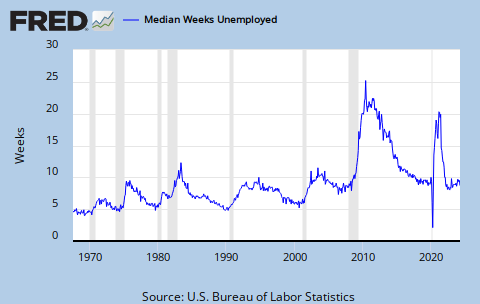
And this is precisely what is happening in the US. Check out this graph of the median duration of unemployment in that country:


There seems to be a sort of "ratchet effect", where even after the recessions (shown in grey) have ended, the median duration of unemployment increases. And what's happened in the last couple of years is something else again. The effect of this on a society cannot be good...

Tuesday, July 6, 2010

Wal-Mart taking a beating

Seems the American consumer's spending spree is slowing:

Wal-Mart Stores (WMT, news, msgs) has a problem: Its typical shopper appears to be tapped out.

The world's largest retailer reported $112.8 billion in worldwide revenue in its fiscal fourth quarter, up 4.6% from a year earlier. But Wal-Mart also said U.S. same-store sales fell 1.6% in the period and noted that traffic in U.S. stores fell slightly. Same-store sales are considered an important measure of a retailer's health.

Wal-Mart's financial results unnerved investors, outweighing plenty of good news in the Bentonville, Ark., company's quarterly report. Wal-Mart has been slashing expenses and inventory, and international sales growth remains strong. Earnings per share last quarter were $1.17, beating Wall Street's estimate of $1.12.

Still, Wal-Mart shares fell 1.1% after the quarterly results were announced on Feb. 18.

One explanation for sales weakness is deflation. The company said prices for groceries and consumer electronics continued to fall, causing customers to spend less on each shopping trip.

The tough economy and high U.S. unemployment are also playing a big role. U.S. consumers are still feeling squeezed, Wal-Mart Chief Financial Officer Tom Schoewe told reporters. "We see the influence of the paycheck cycle as pronounced now as it's been in the past," he said, according to Bloomberg News.

From here (h/t Mega at iTulip). The risk of a double dip is increasing, I think.

Wednesday, June 30, 2010

How long will the recovery last?

So far, the world economy seems to be on an upswing from the depths of the last couple of years. The participants in the G20 meeting have, in fact, agreed to slash their deficits by half. But is it really time for this? Paul Krugman thinks not:
Recessions are common; depressions are rare. As far as I can tell, there were only two eras in economic history that were widely described as “depressions” at the time: the years of deflation and instability that followed the Panic of 1873 and the years of mass unemployment that followed the financial crisis of 1929-31.

Neither the Long Depression of the 19th century nor the Great Depression of the 20th was an era of nonstop decline — on the contrary, both included periods when the economy grew. But these episodes of improvement were never enough to undo the damage from the initial slump, and were followed by relapses.

We are now, I fear, in the early stages of a third depression. It will probably look more like the Long Depression than the much more severe Great Depression. But the cost — to the world economy and, above all, to the millions of lives blighted by the absence of jobs — will nonetheless be immense.

And this third depression will be primarily a failure of policy. Around the world — most recently at last weekend’s deeply discouraging G-20 meeting — governments are obsessing about inflation when the real threat is deflation, preaching the need for belt-tightening when the real problem is inadequate spending.

From the New York Times (h/t flintlock at iTulip). Despite the dismissive attitude taken by flintlock and other iTulipers in that thread, I don't think Krugman's warnings should be ignored.

Sunday, May 30, 2010

House seized over $363 water bill

In the US it's common for municipalities to sell the rights to collect on utility bills, much as they do with property taxes. Sometimes the results are horrible:


Via LargoWinch in this iTulip thread. Possibly the most perverse aspect of this is that the house this unfortunate woman was evicted from was still vacant months after the fact. Lovely, eh?

Sunday, May 16, 2010

More on that "recovery" thing

It's become a mantra in the mainstream business press to say that we're in a recovery. But what does that mean? David Rosenberg has this to say (h/t pogge):
There are classic signs indeed that the recession in the U.S. ended last summer — output, sales, etc. But the depression is ongoing and the reason we say that is because real personal income, excluding handouts from the government, has barely budged. In fact, real organic personal income is nearly $500 billion lower now than it was at the peak 16 months ago and this has never occurred before coming out of any technical recession. It is a depression, as the chart below attests — that is the trendline for real household incomes, until the government comes in to top them off with handouts, subsidies and extended jobless benefits. The share of U.S. personal income being derived from Uncle Sam’s generosity has risen above 18% for the first time ever.
What's going on here? Simply put, a recession is defined solely in terms of overall GDP. If the GDP declines for two consecutive quarters, the economy is considered to be in recession; once it gets back on a solid growth track the recession is considered to be over. We normally think of a "depression" as simply a large recession, but I think Rosenberg is suggesting that it should be seen as a measure of how people are actually faring (what a radical idea!) So a "jobless recovery", or a recovery in which people are going back to work but at lower wages, would be a continued depression, because people's actual wages are depressed.

Thursday, May 6, 2010

Chronic unemployment in the US

The situation is really bad:

Just one in five people who were out of work last summer have found jobs since then.

Of more than a thousand unemployed people surveyed by Rutgers University researchers last August, just 21 percent had landed a job by March, a followup survey reveals. Two-thirds remained "unemployed" according to the government's definition -- the rest gave up looking for work altogether, either going to school or retiring early.

From the Huffington Post, via Rajiv in this iTulip thread. I wonder what this is going to mean for the future? If there are a lot of chronically unemployed people, the social effects of this could be far-reaching.

Thursday, April 15, 2010

Some comments on those green shoots

We're hearing everywhere that the economy is now recovering. Hugh McFadyen and his motley crew are using this as ammunition against the Selinger government, saying that there's no reason to run deficits any more, because the recession is supposedly over. Now technically that may well be true, since recessions are generally defined solely in terms of the overall growth rate of the economy. And there have been gains in jobs lately, too -- but what sort of jobs are they? Armine Yalnizyan at Progressive Economics has some comments:
Forget total employment numbers, it’s the types of jobs coming back that count.

There is a shadow side to this recovery that may undo it in the end. Uncertainty is fast becoming the new normal in the labour market, and that has long-term implications for aggregate demand, household indebtedness, and the rate of defaults on mortgages and credit cards.

The latest Labour Force Survey results show that — though there are still 253,000 fewer jobs than when the recession began in October 2008 — employment growth continues its slow path upward. As Erin Weir noted on Friday, this month’s rising head count is driven by part-time jobs.

By March 2010 there were 47,800 more part-time jobs than when the recession began, but we are still down 300,000 full-time jobs. That mirrors another shift from stable to unstable jobs: more temporary jobs, fewer permanent ones.

And that's based entirely on "pure" economics, and doesn't take into account the fact that oil is likely to get a lot more expensive soon. Throw in that element and things could get quite unpleasant indeed.

Monday, March 22, 2010

Manitoba's credit unions oblivious to downturn

While commercial banks around the world are in dire straits, their cooperative cousins, at least in Manitoba, are doing just fine, thank you very much:

Somebody forgot to tell Manitoba's credit union system about the economic downturn.

The province's 44 credit unions posted double-digit and near-double-digit returns across their major indicators in 2009 -- deposits were up 10.5 per cent to about $15.9 billion, loans increased 11 per cent to about $13.5 billion and assets jumped 9.8 per cent to about $15.9 billion.

From the Winnipeg Free Press.

Wednesday, January 20, 2010

Not clear sailing for the economy yet...

China's being cautious, so markets are running scared:

The Canadian dollar plummeted more than a cent Wednesday and markets dove on concerns that China will curb bank lending and slow the economic recovery.

Traders were responding to a newspaper report that some Chinese banks have been ordered to stop lending for the rest of January after exceeding credit limits.

The Canadian dollar closed down 1.51 cents to 95.51 cents US. Oil ended the day off $1.40 at $77.62 US a barrel. The February gold bullion contract on the Nymex closed down $27.40 to $1,112.30 US.

The markets also ended lower, although they had recovered somewhat from their bigger losses earlier in the day.

The S&P/TSX composite index in Toronto was down 84.1 points to 11,679.3.

The Dow Jones Industrial Average was off 122.28 points, or more than one per cent, at 10,603.15, and the Standard & Poor's 500 share index was down one per cent at 1,138.04.

The Nasdaq composite index ended down 29.15 at 2,291.25.

The Canadian dollar fell against the U.S. dollar, which strengthened as investors sought safety in American short-term debt. Traders also saw little cause for Canadian interest rates and the loonie to appreciate, after a report showing the annual inflation rate rose to 1.3 per cent, or less than expected, last month.

Scotiabank deputy chief economist Aron Gampel told CBC News that investors are now realizing their expectations about the rate of recovery and the growth in corporate earnings may have been overly optimistic.

"Even through the earnings growth is there, the expectations haven't been met," he said. "We've been raising the bar on expectations because the economy seems to be taking off and everyone's expecting profits to rebound quarterly, so any disappointment is having some impact on the outlook and clearly it takes some of the shine off of the markets and the currencies."

From the CBC. I still think there's a significant chance of a double dip recession, or at least a lengthy "jobless recovery".

Monday, December 7, 2009

A fresh take on deficits

We often hear that deficits are getting out of control and that we have to cut spending drastically, regardless of how much need there might be for that spending. But is it really necessary? Stephanie Blankenburg thinks not:

What to do about Britain's national debt and its annual government deficits in the here and now remained less clear. Had deficit spending not been once and for all discredited at the end of the 1970s? Was John Maynard Keynes really about budgetary spending in times of crisis or did he not rather regard fiscal expansion as a secondary tool to be employed, where absolutely necessary, alongside long-term monetary policies (low long-term interest rates) to keep business cycle fluctuations under control?

All true and valid. But for a hands-on perspective on current national debt and government deficits, it is well worth keeping in mind two basic points. First, the current deficit hysteria – to use Samuel Brittan's term – has no historical grounding. Britain's national debt currently runs at about 40% of GDP. Depending on who you believe and what parts of bank debt are counted as national debt, it is predicted to either stay close to 40% or increase to anywhere between 60% and 100% over the next few years. Between 1918 and 1961, UK national debt averaged well above 100%, remaining closer and, at times above, 200% for the best part of this period. What was achieved? Fascism was defeated and the foundations of a modern welfare state were laid. Since the mid-1970s, UK national debt has oscillated between 30% and 40%, at the beginning of the 1990s falling to below 30% for a few years. What was then achieved? Finance-led corporate capitalism rose to power, leaving behind an all but destroyed manufacturing sector in the UK, rising income inequality and, eventually, a financial sector in tatters. And last, not least, wars are being lost.

From the Guardian. Trouble is, it may be hard to sell the public on this idea, given the pathological fear of deficits that's been drummed into us for the last few decades.

Saturday, December 5, 2009

So are we out of the woods yet?

In the last couple of days there have been a few good news stories about the economy. The US lost 11,000 jobs in November, which sounds like bad news until you read on and see that the pundits were predicting more than ten times that. Paradoxically, their unemployment rate actually dropped. The paradox is resolved when you realize that the unemployment rate is based on the number of people actively seeking employment... but more on that in a moment. In Canada, we had a net gain of 79,000 jobs. And gold is down, which is usually seen as a sign of improved confidence in the economy (or at least the value of the US dollar).

However, we shouldn't assume that it's going to be clear sailing from here on in. For instance, looking at the American stats, there's still a net loss of jobs... which implies that the drop in the official unemployment rate may be because of people who have given up looking for work and have gone back to live with their long-suffering parents. And the job stats do not necessarily reflect quality; if an auto worker is laid off from a $50,000 a year job, but two fast food workers are hired at $18,000 a year, that is a net gain in employment, but it isn't really a favourable economic indicator. Note too that retail sales on Black Friday fell short of expectations (don't get me wrong, I'm no fan of the crazy consumer culture that surrounds that day, but it is an indicator of public confidence). And on the international front there may still be some shocks awaiting us. Canadian Silver Bug reminds us that the Dubai crisis may not be the last, and identifies Japan, the UK, and Russia as potential trouble spots. And of course, a default by any of those countries would have dramatic effects on the global economy, which might mean big trouble ahead... although I suspect creditors might be willing to renegotiate things before it gets to that point, because they could stand to lose a lot from the secondary effects of such a default.